
Emsella Treatment vs. Kegel Exercises and Pelvic Floor Therapy: Why the Non-Invasive Chair Wins Every Time

If you've ever been told to “just do your Kegels” for urinary leakage, pelvic floor weakness, or bladder control, you already know the problem: remembering to do them is one thing. Doing them correctly, consistently, and with enough intensity to make a meaningful difference is another.
That is where the conversation around Emsella vs Kegel exercise gets interesting.
Let's be clear: Kegel exercises work for muscle contraction. Pelvic area muscle training is one of the most established conservative approaches for urinary incontinence, and research shows that consistent pelvic floor training can improve symptoms and quality of life.
But what if you could strengthen those same muscles without having to remember every contraction, master perfect technique, or find time for another daily exercise routine?
That's the idea behind Emsella.
Instead of asking you to consciously contract your pelvic floor over and over again, BTL Emsella works by using High-Intensity Focused Electromagnetic technology to stimulate the pelvic floor for you. A single approximately 28-minute session produces about 11,200 pelvic floor muscle contractions.
For someone who has struggled to make Kegels part of their routine, that difference can be significant when it comes to pelvic health.
Kegels Work—So Why Look for Other Treatments for Pelvic Floor Strengthening?
Kegels are simple in theory. Contract the pelvic floor muscles, hold the contraction, relax, and repeat.
Over time, repeated contractions can help strengthen the pelvic floor and improve endurance and coordination. In fact, evidence reviews have found pelvic floor muscle training can increase the likelihood of improvement or cure for urinary incontinence.
The challenge isn't necessarily whether Kegels work as a treatment option or not.
The challenge is execution.
Your pelvic floor isn't a muscle you can easily see in the mirror. You can't watch it contract the way you can watch your biceps curl. That makes it surprisingly easy to use the wrong muscles, contract too weakly, hold your breath, or compensate with your abdomen, thighs, or glutes.
Research has demonstrated just how real this technique issue can be. In one study of postmenopausal women, 32% were unable to correctly perform the first pelvic-floor contraction before receiving biofeedback training.
And even when someone knows exactly how to perform a Kegel, there's another hurdle: consistency.
Life gets busy. You forget. You get distracted. You skip a day, then several days. Eventually, an exercise intended to become a daily habit becomes something you remember only when you experience another bladder leak.
That's the gap Emsella is designed to address.
BTL Emsella vs Kegel Exercise: The 11,200-Contraction Difference
Imagine trying to complete thousands of pelvic floor contractions on your own.

That's where the Emsella vs Kegel exercise comparison becomes especially compelling.
During an approximately 28-minute Emsella treatment session, HIFEM technology induces about 11,200 pelvic floor contractions.
You don't have to count them.
You don't have to remember to squeeze.
You don't have to wonder whether you're contracting the correct muscle.
And you don't have to spend the session consciously thinking about your pelvic floor.
You simply sit in the Emsella chair, remain fully clothed, while the technology delivers the stimulation and you can go back to regular daily activities directly after.
The contractions produced by Emsella are described as supramaximal pelvic floor muscle contractions, meaning the electromagnetic stimulation can induce contractions beyond what a person would typically produce voluntarily. Clinical research has investigated Emsella's ability to stimulate both deep and superficial pelvic floor musculature and its potential effects on pelvic floor strength and urinary symptoms.
That makes Emsella less about replacing the concept of pelvic floor exercise and more about changing how the exercise is delivered.
Why Most People Don't Get Long-term Results From Kegels
So, are Kegels enough for treatment of urinary incontinence?
For some people, absolutely.
But “Kegels work” and “Kegels are easy to do correctly and consistently” are two very different statements.
Effective pelvic floor training depends on several factors:
Correctly identifying the pelvic floor muscles
Performing the contraction correctly
Using an appropriate intensity
Repeating the exercises regularly
Maintaining the routine long enough to see improvement
Evidence also suggests that more intensive pelvic floor muscle training and strategies that encourage continued adherence can improve outcomes.
That's a lot to ask of someone who is already dealing with leakage, urgency, postpartum changes, aging-related pelvic floor weakness, or the demands of everyday life.
This is why the appeal of Emsella isn't simply that it is “easier.”
It's that the technology takes the active contraction out of your hands.
Instead of relying entirely on your ability to voluntarily generate and repeat supramaximal contractions, Emsella uses focused electromagnetic energy to trigger them for you.
Pelvic Floor Exercise vs. Technology: Which Makes More Sense for Pelvic Health?

The better question may not be whether pelvic floor exercise or technology is “good.”
It's which approach fits your needs, your body, and your lifestyle?
Traditional pelvic floor exercises remain an important tool. Pelvic floor physical therapy can also provide individualized instruction, assessment, and guidance—particularly for people who need help learning proper technique or who have more complex pelvic floor concerns.
Emsella offers a different approach.
Rather than requiring you to actively perform thousands of contractions yourself, the chair delivers the stimulation while you remain seated and sit fully clothed.
For someone who has tried Kegels but struggles with technique, consistency, or simply finding the time to do them, that can be a major advantage and improve quality of life.
Think of it this way: Kegels require you to do the work. Emsella is designed to do the contracting for you.
Emsella Results vs. Pelvic Floor Physical Therapy: Is One Better?
It's tempting to frame Emsella results vs pelvic floor therapy as an either/or decision for a weakened pelvic floor, but pelvic floor health isn't always that simple.
Physical therapy has strong evidence behind pelvic floor muscle training, and it can be an excellent solution to pelvic health, pelvic floor dysfunction and incontinence treatment for many patients.
Emsella meanwhile, offers a non-invasive technology-based approach to pelvic floor stimulation. Research has reported improvements in pelvic floor strength and stress urinary incontinence symptoms following treatment.
For many people, the biggest advantage of Emsella is convenience when it comes to pelvic floor treatments.
You don't need to perform the exercises yourself.
You don't need to remove your clothing.
You don't need downtime afterward.
The Bottom Line: Kegels Work But Emsella Makes it Easier and More Effective
The goal isn't to pretend Kegels don't work.
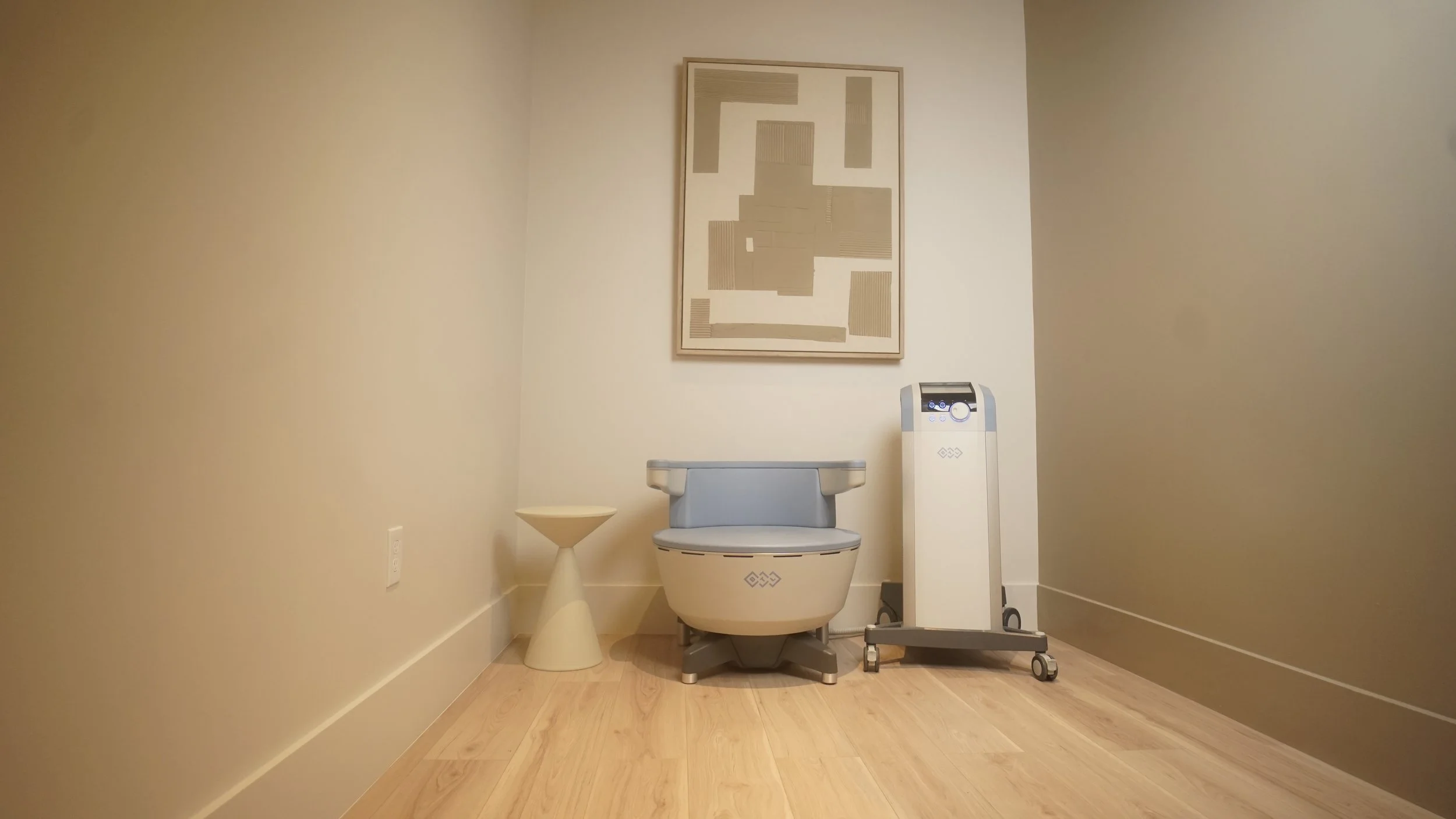
Emsella Treatment Room at Revique Medical & Aesthetics in Arlington, TX
They do.
The problem is that knowing an exercise works doesn't automatically mean you'll perform it perfectly—or perform it often enough.
That's where using the Emsella chair can offer a compelling alternative and effective solution for a stronger pelvic floor.
With approximately 11,200 pelvic floor contractions in a single 28-minute session, Emsella provides a level of automated, high-volume stimulation that would be difficult to replicate as part of a typical self-directed exercise routine.
Instead of wondering, “Am I doing this right?”
You can simply sit down and let the technology work.
If bladder leakage, urgency, or pelvic muscle weakness is affecting your confidence or quality of life, it may be time to consider a different approach.
Ready to Let the Chair Do the Work and Get a Personalized Treatment Plan?
If you're in Arlington, TX, and want to learn if Emsella is right for you and how pelvic floor strengthening works? Schedule a consultation with Revique Medical & Aesthetics to develop a personalized treatment plan and see long-term results. Pelvic floor health is essential to wellness, longevity and living loudly. Pelvic health concerns and experiencing pelvic floor weakness is not something you have to live forever with.
Revique offers Emsella for urinary leakage and pelvic floor issues in a private, medically focused setting. Discover what 11,200 pelvic floor contractions can do for you.
